
You have a 3D file ready, a prototype to validate or a small batch to launch. Then the service provider asks: "FDM, SLA or SLS?" This choice has a direct impact on the price, lead time, accuracy and strength of your parts.Photo idea (cover): the same part printed in FDM, SLA and SLS, side by side on a workshop bench, with a neutral background and low-angle light to show the surface differences. Alt text: "Comparison of a part printed in FDM, SLA and SLS at InspireTech".
This guide compares the three most widely used 3D printing technologies, in Tunisia and worldwide. You will learn how each one works, its strengths, its limits and, above all, which one to choose for your project. It is written for startups, engineers, students and manufacturers who want to make the right decision from their very first order.
The short answer
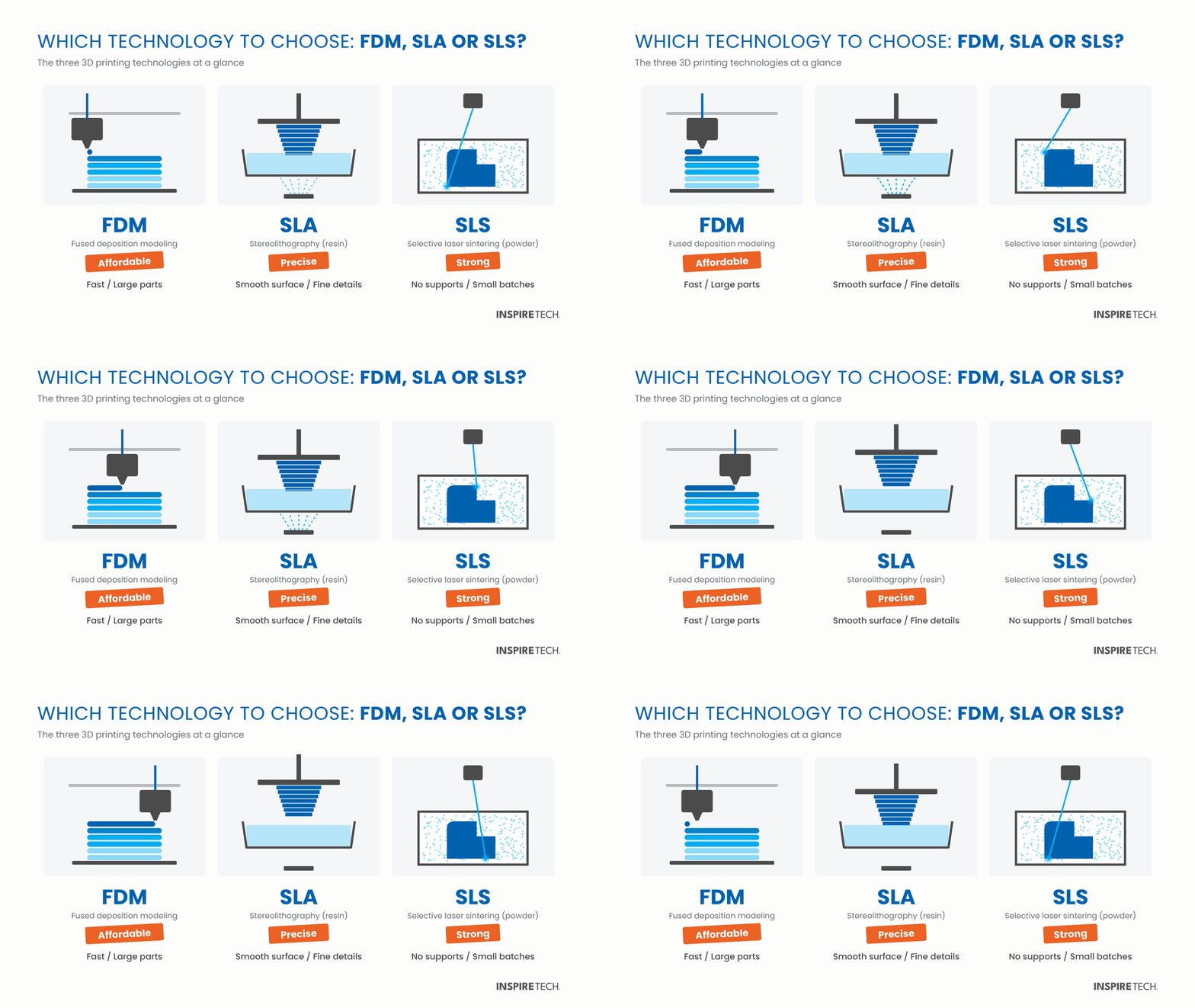
If you only have a minute, here is the simple rule:
- FDM: the most affordable and fastest option, ideal for prototypes, simple functional parts and large parts.
- SLA: the choice for accuracy and a smooth finish, ideal for small detailed parts, presentation models and molds.
- SLS: the choice for strength and design freedom, ideal for demanding functional parts and small production runs.
The rest of this article explains why, with real-world cases to help you decide.
FDM: the most accessible technology
FDM (Fused Deposition Modeling), also called FFF, is the most widespread 3D printing technology. It is the one you find in fablabs, schools and at most service providers.
How does FDM work?
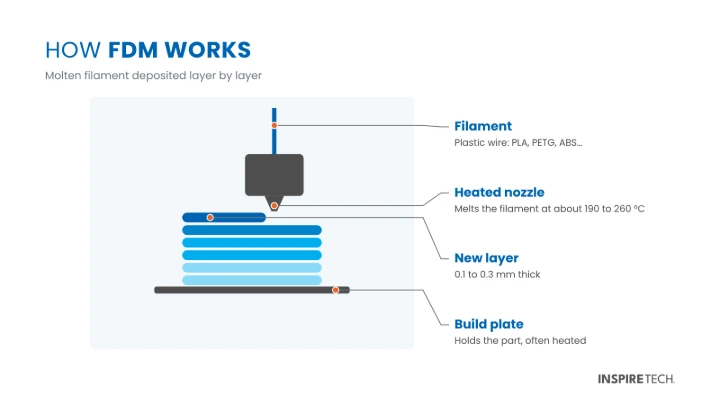
A spool of plastic filament is heated and pushed through a nozzle. The nozzle lays down the molten plastic layer by layer, like a very precise glue gun. Each layer cools and hardens before the next one. Layer height usually ranges from 0.1 to 0.3 mm.
The advantages of FDM
- The lowest cost of the three technologies, for both the machine and the material.
- Short lead times: a simple part can often be printed in a few hours.
- A wide choice of materials: PLA, PETG, ABS, ASA, flexible TPU, nylon, carbon-fiber-filled composites.
- Large parts are possible without blowing the budget.
The limits of FDM
- Layers are visible to the naked eye, which gives a ribbed look.
- Accuracy is moderate: often expect ±0.2 to ±0.5 mm depending on the part.
- The part is weaker between layers (Z axis) than in the horizontal plane.
- Overhangs need supports, which have to be removed afterwards.
What is it used for?
FDM is perfect for a first prototype, a fit and form check, workshop jigs and fixtures, brackets, enclosures or large parts. It is often the best entry point for a startup that iterates quickly on its product.
SLA: the technology of precision
SLA (stereolithography) is the oldest 3D printing technology. It remains the reference when you need fine details and a smooth surface. DLP and LCD (MSLA) are very close variants.
How does SLA work?
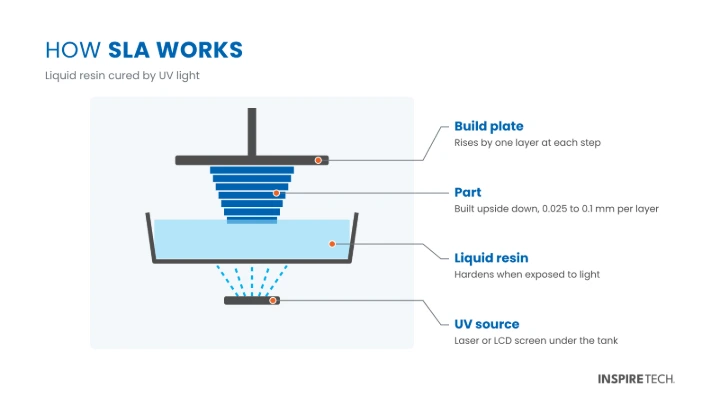
The machine uses a liquid resin that hardens when exposed to light. A light source (laser or UV screen) cures the resin point by point, layer after layer. Layers are very thin, often between 0.025 and 0.1 mm. After printing, the part is washed in alcohol and then placed in a UV chamber to finish curing.
The advantages of SLA
- Very high accuracy: often around ±0.1 mm on small parts.
- A smooth surface, with almost no visible layers, close to a molded part.
- Very fine details: engraved text, small clips, threads, organic shapes.
- Specialized resins: clear, rigid, flexible, heat-resistant, dental or castable for foundry work.
The limits of SLA
- More brittle parts than technical FDM or SLS, especially with standard resins.
- UV sensitivity: some resins turn yellow or become brittle in sunlight over time.
- A build volume that is often smaller, and a higher resin cost.
- Mandatory post-processing: washing, support removal, post-curing.
What is it used for?
SLA is ideal for presentation models, aesthetic prototypes, small precise mechanical parts, jewelry, dental applications and masters for silicone molding. If your part needs to look good and be precise rather than very strong, it is often the right choice.
SLS: the technology for functional parts
SLS (Selective Laser Sintering) is an industrial technology. It produces strong, ready-to-use parts and suits both prototypes and small production runs.
How does SLS work?
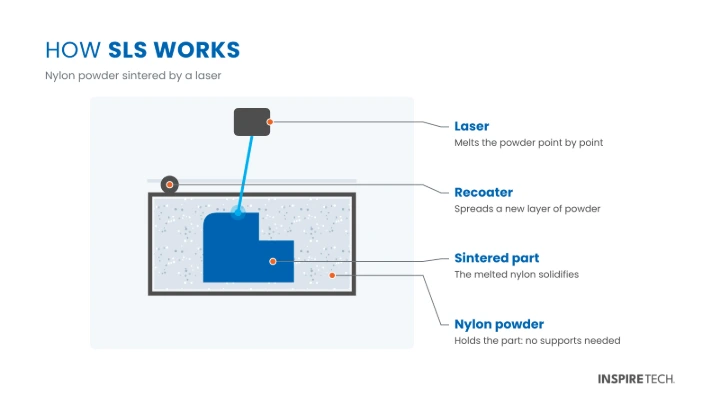
The machine spreads a thin layer of plastic powder, most often PA12 nylon. A laser melts the powder where the part should be. A new layer of powder is then spread, and so on. The unmelted powder supports the part during printing: no supports are needed.
The advantages of SLS
- Strong, durable parts, with strength close to injection-molded parts and more consistent in every direction.
- Complete design freedom: internal channels, interlocking parts, hinges printed in one piece.
- Efficient batch production: you can fill the entire machine volume with dozens of parts in a single print.
- Good chemical and heat resistance thanks to nylon.
The limits of SLS
- A higher cost for a single part, because the machine works in batches.
- A slightly grainy, matte surface, which needs treatment if you want a smooth look.
- A limited choice of colors: parts come out white or gray, but they can be dyed.
- Sometimes longer lead times, due to cooling time and the grouping of orders..
What is it used for?
SLS is the right choice for mechanical parts that really have to work: clips, hinges, enclosures for finished products, drone and robotics parts, prostheses and orthoses, or runs of 10 to a few hundred parts without investing in a mold.
FDM vs SLA vs SLS comparison table
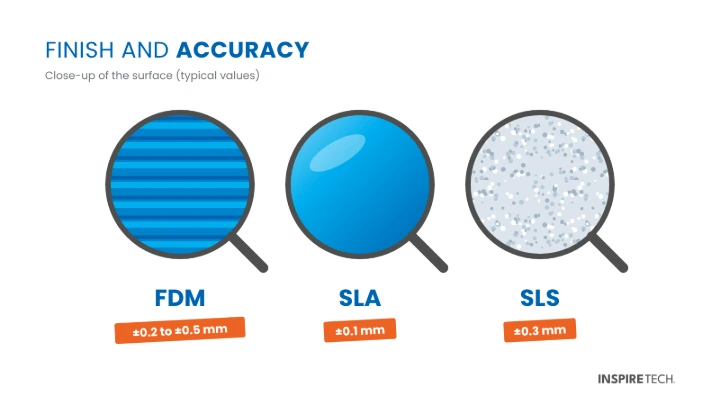
This table sums up the key differences. The values are common orders of magnitude: they vary with the machine, the material and the part geometry.
Criterion | FDM | SLA | SLS |
|---|---|---|---|
Raw material | Plastic filament | Liquid resin | Powder (PA12, PA11 nylon…) |
Layer height | 0.1 to 0.3 mm | 0.025 to 0.1 mm | about 0.1 mm |
Typical accuracy | ±0.2 to ±0.5 mm | ±0.1 mm | ±0.3 mm |
Surface finish | Visible layers | Very smooth | Matte, slightly grainy |
Mechanical strength | Medium to good | Low to medium | Very good |
Supports needed | Yes | Yes | No |
Cost per part | € (the lowest) | €€ | €€€ (drops in batches) |
Typical lead time | The shortest | Short | Longer (batch-based) |
Best for | Fast prototypes, large parts | Fine details, aesthetics | Functional parts, small runs |
Which technology should you choose for your project?
The right choice depends less on the technology itself than on what your part has to do. Ask yourself three questions: what will the part be used for, how accurate does it need to be, and how many copies do you need?
Your need | Recommended technology | Why |
|---|---|---|
Check a shape or fit | FDM | Fast and affordable, finish matters little |
Show a product to investors or customers | SLA | Smooth, professional look, easy to paint |
Test a mechanical part (clip, hinge, assembly) | SLS | Strong and resistant in every direction |
Make a large part (over 30 cm) | FDM | Large build volume at a controlled cost |
Small, highly detailed parts (jewelry, dental, miniatures) | SLA | Fine details and smooth surface |
Small run of 20 to 300 parts | SLS | Batch production, no mold |
Workshop jigs, fixtures and brackets | FDM | Useful parts, quickly replaced |
Flexible part (seal, protection, insole) | FDM (TPU) or SLS (TPU) | Flexible materials available |
Three real-world examples
A medtech startup is developing an orthosis. The first versions are printed in FDM to check the fit on the patient. Once the design is stable, the trial version is produced in SLS for its strength and lightness.
A designer is preparing the launch of a connected device. The demo enclosure is printed in SLA, sanded and painted. It looks like a finished product for photos and trade shows.
A manufacturer needs 150 plastic spare parts. An injection mold would be too expensive for this quantity. SLS can produce them in one or two batches, with strength suited to the use.
What if your project evolves?
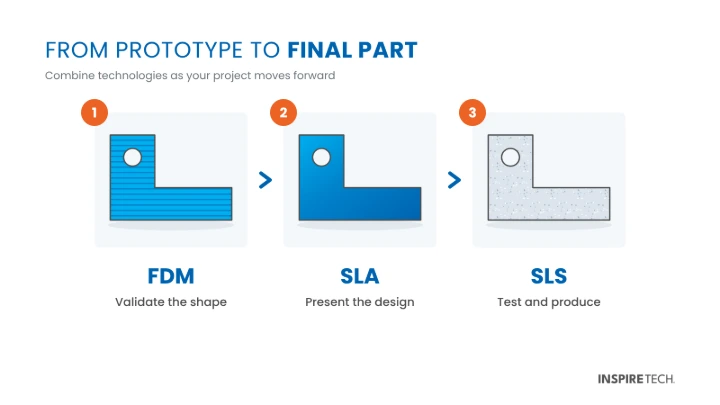
In most product projects, technologies are combined. You start in FDM to iterate fast and cheaply, then move to SLA or SLS once the design stabilizes. This step-by-step approach lowers the total development cost.
3D printing prices and lead times in Tunisia: what drives the cost
The price of a 3D printed part does not depend on the technology alone. Five factors weigh on the quote:
- Material volume: the more solid the part, the more it costs. In FDM, partial internal infill greatly reduces this item.
- Part height: in FDM and SLA, print time depends mainly on the number of layers. Laying a part flat can therefore shorten the lead time.
- Required accuracy: thinner layers give a better result but increase machine time.
- Quantity: in SLS especially, the unit price drops sharply when a full batch is filled.
- Post-processing: sanding, painting, dyeing, threaded inserts or polishing add to the printing price..
Typical lead times
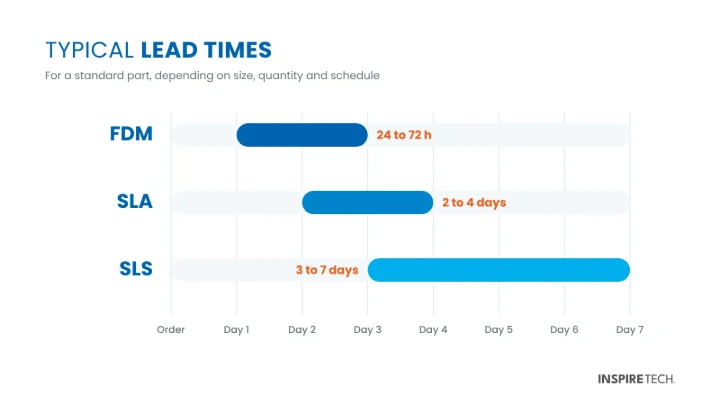
For a standard part, expect generally 24 to 72 hours in FDM, 2 to 4 days in SLA and 3 to 7 days in SLS. These lead times vary with part size, quantity and the production schedule.
The advantage of producing in Tunisia
Ordering locally avoids customs fees, import delays and difficult long-distance exchanges. You can talk directly with an engineer, see a sample and correct your design between two versions in just a few days.
To get an exact price, the easiest way is to send your STL or STEP file. At InspireTech, you can get an instant quote for your part..
5 common mistakes to avoid
- Choosing SLA for a part that has to absorb impacts. A standard resin is precise but can break. For a mechanical part, prefer SLS or an engineering resin.
- Demanding a perfect finish for a first prototype. At this stage, FDM is often enough. Save the budget for later versions.
- Forgetting assembly tolerances. Two parts that must fit together need clearance, usually 0.2 to 0.5 mm depending on the technology.
- Sending an unchecked file. A model with walls that are too thin or open surfaces can fail to print. Check that walls are at least 1 to 2 mm thick, depending on the technology.
- Not mentioning the final use. The same shape may call for a different technology depending on whether it stays in an office, sits in full sun or goes inside an engine..
Conclusion : le bon choix dépend de votre pièce
Il n'existe pas de meilleure technologie dans l'absolu. Le FDM est votre allié pour itérer vite et à petit prix. Le SLA s'impose quand la précision et l'aspect comptent. Le SLS est la solution pour des pièces solides et des petites séries prêtes à l'emploi.
Conclusion: the right choice depends on your part
InspireTech est une microfactory tunisienne spécialisée dans le prototypage et la fabrication de produits. Nos ingénieurs analysent votre fichier et vous conseillent la technologie et le matériau les plus adaptés à votre usage et à votre budget.
- Vous avez déjà votre fichier : obtenez un devis instantané.
- Vous avez une idée mais pas encore de modèle 3D : parlez à un expert.
- Découvrez nos services d'impression 3D et notre service de scan 3D et rétro-ingénierie.